Friday, September 15, 2017

Digital kitchen

Which app to choose

I have been using Bento for my recipes on my desktop and mobile. This was always kind of clunky and try-hard (a bit like the author - come on, I hear you...). Now it is part of the app graveyard for iOS 11, I'm having to make a move. But where to?

Free options

Evernote is what I use most. You can clip from the web, type in manually with lists, checklist and rich text tools. You also tag and sort/search by tag or free text search. You just create a notebook called "recipes" and away you go.

It's a web app, mobile and desktop - so it's pretty much anywhere anytime and one of the most indispensable digital tools out there.

I miss the "Food" app that Evernote no longer supports - which was basically a re-skin of your recipe notebook.

Google Docs will also do most of what you need, and you can share with the Google community pretty easily.

Collecting

The options above are mostly for organising your own recipes - though both with also handle links of course, and Evernote's clipping is pretty good. Other free collectors include Pinterest and Reddit. Copy Me That is a web app and on mobile. There is also a Google Chrome extension. It is also well worth a look.

Paid apps

Paprika has many admirers. It has lots of features and scaling recipes up and down, shopping list creation and exporting to Reminders or Calendar. But I don't like how you have to pay twice - for the desktop and for the iPad app - and the app appears to be iPad only, not phone. There is also no suck it and see option that I can find.

The one I'm currently using is Recipe Keeper. I like its clean interface and that it works on both phone and tablet. There's also a Windows version on the Microsoft store apparently, but no Mac version yet. So far I like it, and you can use it fully featured up to 20 recipes before deciding to buy.

What it lacks is a good export tool so that you can share (or move) the recipe itself rather than a link to it.

Any other suggestions?

Sunday, July 2, 2017

How to poach an egg

Eggsplanation

The trick with eggs - poached, scrambled, boiled, fried or coddled - is to be gentle, especially with the heat.

And eggs are cheap - so you can afford to buy eggs that are gentle on their mothers. A dozen cage free eggs weighing in at 700g cost $3.50. Less than 30 cents an egg.

And a poached egg is a prince at that price.

The way I do it is basically the Heston method with a few changes.

First, I don’t use a thermometer, and second I don’t put my plate in upside down. I found with the plate upside down, the eggs tend to slide off and end up off touching side of the pan, which defeats the purpose.

Most good quality plates have a rim at the bottom, which lifts the surface away from the direct heat, and this combined with removing the saucepan from the heat does the trick.

What you need

  • Bread-and-butter plate
  • Saucepan just large enough for the plate
  • Slotted spoon
  • Small bowl
  • Spatula

Method

Pour about 6cm of water into the saucepan and bring to boil. Once it’s boiling, remove from heat. Wait 1 minute, then slide in the plate right-side up.

Prepare the egg by breaking it into a slotted spoon over a bowl or paper towel so that the watery yolk is discarded. With the slotted spoon, gently slide the egg into the water - you do this by lowering the spoon into the water, then gently letting the egg slide out onto the plate.

If you are doing more than one egg (and you generally will be) take note of which is first, second and third so that you can remove them in that order. For more than that, you will need a new batch - or two saucepans.

Once the eggs are in, I put the toast on. In three minutes the first egg will be ready. Remove from the water with a spatula - if you want it to be really fancy, you can trim the edges of the egg. But, as you can see, I can’t be bothered doing this - I just want to eat it.

Season with salt and pepper. Also a tomato salsa is nice. I also find tamarind sauce or chutney goes very, very well with egg.

Thursday, June 1, 2017

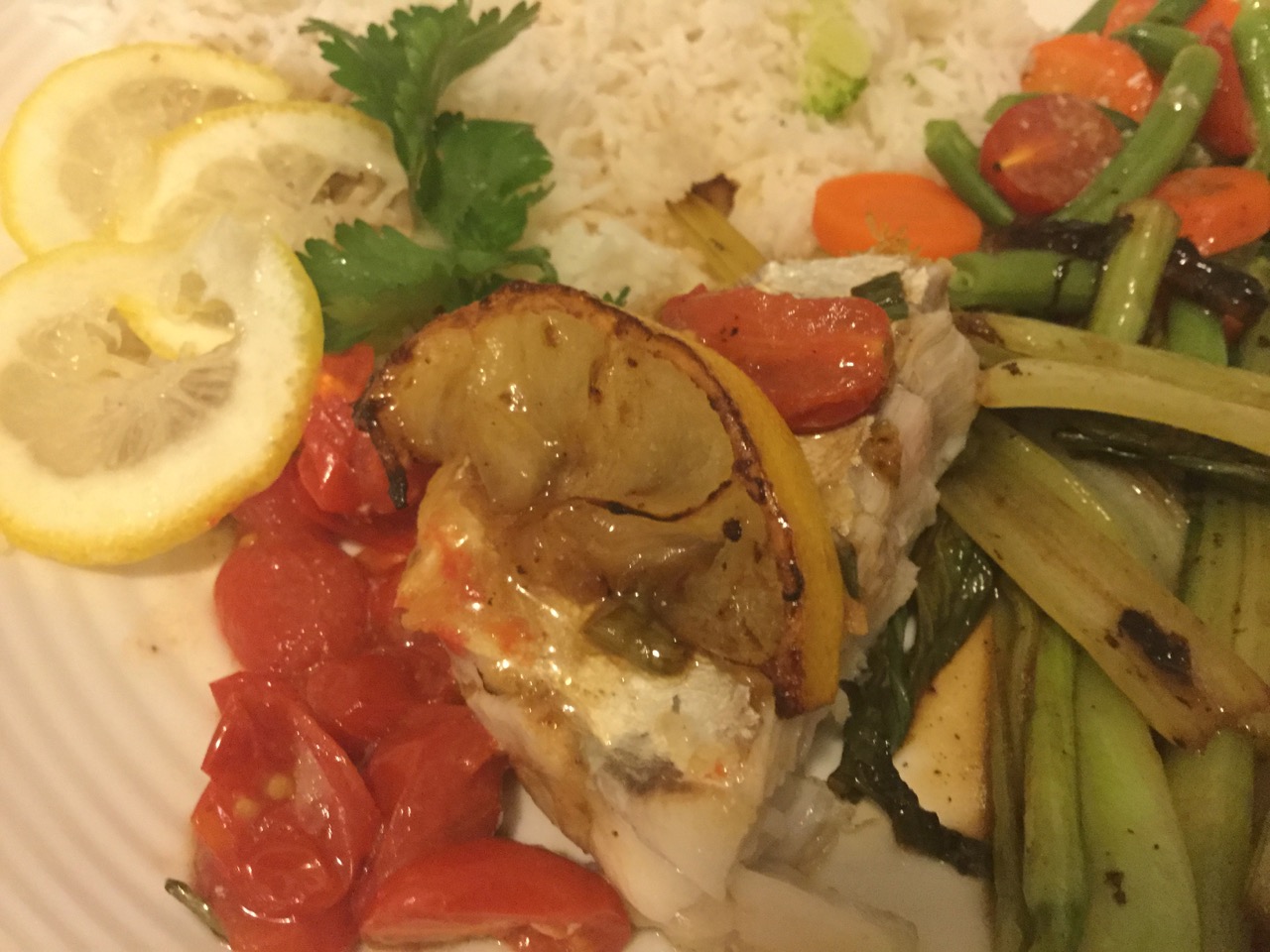
Wrapped fish fillet bake

I have decided that Wednesday night is seafood night. Quick to cook, and I buy fresh from Paddy’s Markets, along with the veggies, and eat with the boys that night. Here is episode one.

The sauce

  • 2 tablespoons light soy sauce
  • 2 tablespoons chopped shallots
  • 1 tablespoon each rice wine, rice vinegar, lemon juice, grated ginger, crushed dried lemon myrtle leaves, peanut oil
  • 1 teaspoon chopped coriander root
  • 1 teaspoon palm sugar
  • 1 pinch white pepper

The fish

  • 1 kg ling fillets cut into large pieces
  • .5 lemon, thickly sliced
  • 4 tablespoons peanut oil
  • About a handful of halved cherry tomatoes
  • Greaseproof paper

Garnish

  • Handful of coriander leaves
  • .5 lemon thinly sliced

Method

Preheat oven to 200ºC

As always, take any refrigerated ingredients out into your kitchen to let them reach room temperature. Combine sauce ingredients in a small bowl and set aside.

Tear off pieces of grease proof paper big enough to easily wrap each piece of fish.

Heat the remaining peanut oil to a high heat. Brown the ling pieces in each side, one at a time - about a minute each side. You just want some brown and crispy patches.

Remove the fillets to a sheet of paper.

Brown the lemon slices on each side.

Add the lemon slices to the fish.

Add the sauce and fold the paper over, collecting the ends in a bunch almost like a bonbon.

Place on a baking try and put into the oven for 10 minutes.

Serve with rice and steamed vegetables.

Wednesday, May 10, 2017

Embrace the bitterness - it's a very bachelor thing to do

Well, it’s more sour than bitter - but you get the picture.

My kaffir lime plant, now fIve years old, has produced good fruit this season. But what to do with it… The limes look great - like little green brains from something little, green and brainy.

There are lots of seeds inside, and a tough and conspicuous core - but the juice is strong and tasty, likewise the rind.

So I found some oranges that needed to be used, rounded up all the sugar in the pantry, and set to work.

I wish I had done this with my recent pickles - for bachelor proportions, turn to the microwave!

Kaffir and orange marmalade

Ingredients

  • 3 medium oranges, peeled, seeded and chopped
  • 3 kaffir limes, cored, seeded and finely sliced
  • 5 cloves
  • Sugar (in this instance I used up all the sugar I had - caster sugar, about 200g, raw sugar, about 200g, and brown sugar, also 200g.
  • Water

Method

  • Prepare fruit, and weigh, then add to about 2 litre mixing bowl. I have found the best way to handle the kaffir limes is to quarter them down the core. That way the core peels away easily in four strips, and the seeds (and there are quite a few of them) are more easily scooped out.
  • Add same weight of sugar, plus a bit more because the kaffir lime is more sour than your average fruit, to mixing bowl
  • Pour in enough water to cover - hold the fruit down with your flat hand, and once the water reacher your knuckles, that is about enough
  • Put in microwave on high for 10 minutes
  • Taste - things you can add if it’s not quite right include more sugar, maybe orange juice, lemon juice
  • Add cloves, stir, and return to microwave on medium for another 10 minutes
  • The mixture should have a fairly homogeneous colour by now, and be close to gel point. You can tell it is at gel point by taking a teaspoon and pouring onto an cold saucer. If it thickens as it cools, it is ready. What you are after is not to be solidly set, but to just holds the spoon and drips out rather than pours freely. If it is still runny, pop the mixture back in the microwave at medium and repeat until gel point is reached.
  • Once you have established gel point, let the mixture cool a little so that it is safe to handle, but not set.
  • Stir, and transfer to sterilised jars, seal, and refrigerate immediately
Yields: 1 kg marmalade for breakfast toast and arvo cheese platter

The juice is the dressing

Simple pickles and how to use them

Last weekend I took the boys to visit their grandma. As we were sorting out the lunch spread, my mum handed me a jar from the fridge and said - polish this off for me.

It was the last of a simple vegetable pickle - mostly pickle juice at this stage. And I thought - what a salad dressing this would make!

So we talked about how the little pickle can be done, and how I could use some spare veggies in my pantry - carrots and white radish. The carrots came from Paddy’s Market, Sydney; the white radish from Throg: the farm from beyond, Wootton.

Ingredients

  • 2 cups shredded carrots and white radish
  • 2 cm cub ginger, sliced
  • 1 clove garlic, sliced
  • 6 or 8 pepper corns
  • .5 teaspoon cummin seeds
  • .75 cup vinegar (e.g. combo white and cider)
  • .25 cup water
  • 1 tablespoon caster sugar
  • 1 teaspoon salt

Method

Combine vinegar, water, sugar and salt, and bring to boil Add the remaining ingredients Bring back to boil and continue until the carrots are softened, but still slightly crunchy Transfer to a sterilised jar with enough juice to cover Refrigerate straight away
Yields: about a jam jar’s worth: approx 360gm

And putting to use…

The boys were back with their mum, so I rebranded the cooked lamb chops into cubes - to make them sort of like little meaty croutons, frying in butter, quickly just to get that crunch. A simple baby spinach leaf and tomato salad, with crispy lamb and pickles. Thank you and goodnight!

Tuesday, February 28, 2017

Gosht saagwala - lamb and spinach

Ingredients

  • .5 kg boneless, cubed lamb
  • 2 medium bunches English spinach, chopped - NOT silverbeet
  • 2 medium onions, chopped
  • 2 cups water
  • .25 cup yogurt
  • 2 tablespoons peanut oil

Marinade

  • .5 cup yogurt
  • 1 tablespoon grated ginger
  • 3 coves chopped garlic
  • 3 chopped coriander roots
  • .5 teaspoon turmeric
  • 1 teaspoon garam masala

Whole spices

  • 2 bay leaves
  • 3 cardamom pods
  • 3 cloves
  • 1 cinnamon stick or bark
  • .5 teaspoon fenugreek seeds
  • 6–8 black peppercorns
  • 1 teaspoon cumin seeds

Side

  • Chopped coriander leaves
  • Chopped tomato
  • Slivered almonds
  • Chopped fresh green and red chilli (optional)
  • Lime slice

Method

Combine marinade and coat lamb pieces and set aside for 30 minutes at least, but several hours or overnight if you can.

Blanch spinach with water and let rest also.

In a casserole dish, dry-fry whole spices until they are fragrant (do not burn).

Add peanut oil, then chopped onion.

Sauté until soft and translucent.

Turn heat to high and add lamb and all the marinade. Use a wooden spoon to stop the mixture from burning at the bottom of the pan.

Once the colour starts to turn a rich, darker colour, add the water from the blanched spinach (I use this water to rinse the marinade bowl), bring to boil, add spinach and yogurt, and simmer, partially covered for 1 hour, or until the liquid reduces and green colour of the spinach intensifies.

Serve with side, using some of this to garnish main.

Monday, July 11, 2016

Stout beef casserole and cottage pie rebrand

Having enjoyed the beef, mushroom, Guinness pies a few weeks ago, I thought I’d push the same idea into a lovely, warm serve of winter heartiness.

This is basically beef bourguignon, but with stout instead of red wine. Serve with creamy mashed potato, and roast broccoli and cauliflower - adding almond slivers is also good, but last night I forgot!

Unlike the pie version, I err on the side of big with the meat pieces. It’s almost like they are little steaks which you’re encouraged to slice and smear with the sauce and mash, rather than just spoon in.

Roast veggie tip: why par boil, when you can par zap? Many roast vegetables benefit from par boiling to soften the centre, so that the outside can be crisped. A couple of minutes in the microwave means less water, less flavour down the drain - and less time wasted. Just saying…

Don't forget the French onions!
For a regular casserole, you pop it covered into the oven for 3 hours. But I use the slow cooker for 8.

As a bachelor dad, I get the recipe to the first stage a night ahead. Then pop it in the fridge.

Next morning, into the slow cooker, and away I go to work. That way, after school when my kids come home, they open the door to that rich and homey smell. They might not be here as often as I’d like, but it’s their home, and their dad loves them. Food can say that.
Serves 4

Ingredients

1kg chuck steak 75g pancetta, roughly chopped 1 cup stout 1 cup beef stock 1 tbsp salt 3 tbsp olive oil 3 tbsp butter 1 brown onion, roughly chopped 2 carrots, roughly chopped 2 garlic cloves, finely chopped 2 tbsp plain flour 3 bay leaves 8 eschalots, peeled 150g button mushrooms, sliced 2 sprigs thyme

Serve with buttery mashed potato and roast broccoli and cauliflower (with slivered almonds - if you remember... )

Method

  1. Cut beef into 4–5 cm pieces.
  2. Place the stout in a saucepan and reduce by a third over a medium-high heat, then add beef stock and bring to a boil.
  3. In frying pan, heat 1 tbsp olive oil and 1 tbsp butter over a high heat. Season the beef with salt and fry in batches until caramelises as the edges and corners. Set the fried beef aside and add another 1 tbsp oil and 1 tbsp butter to the dish. When the butter is foaming, add the onion and carrot and reduce heat to medium-low . Cook for about 8 minutes, then add the garlic. Cook for a further 4 minutes, then add flour , mix through and gently cook for about 3 minutes.
  4. Gradually pour the hot stout and stock mixture over the onion and carrots, stirring to ensure no lumps form. Bring to a gentle boil. Return the beef to the pan with any resting juices and bay leaves. (Stage 1 complete) Cover and cook in oven for 2 ½ hours in oven, or 8 in slow cooker.
  5. In a frying pan, heat the remaining oil and butter on a medium-high heat, add pancetta and cook until lightly coloured, about 4 minutes, then remove from the pan. Add the eschalots and cook until they deepen in colour (about 3–4 minutes), then remove. Finally, add the mushrooms and lightly sauté (about 4–5 minutes).
  6. Add the pancetta, eschalots, mushrooms and thyme leaves to the braised beef. Cook for a further 15 minutes. Serve with buttery mashed potato, extra thyme and freshly ground pepper, and roast veggies.

Rebrand

Next day, pull out the leftovers from the fridge and cut the beef and veggies into small pieces. Scoop up all the sauce, and place everything into a pie pot.

Take the mash leftover and combine with 2 tablespoons of breadcrumbs and 1 tablespoon of grated pecorino cheese.

For best results, as ever, let the whole lot come to room temperature.
Preheat oven to 160º

Top the casserole pie filling with the mash mix, fluffing it up with a fork. Cook in the oven for 30 minutes. If necessary, pump up the heat at the end to get the browny edges happening.